Crimean Tatar custom of male-only funerals
Grey BeesThe Crimean Tatar custom of male-only funerals reserves the public funeral rites for men, while women and children say their goodbyes at home. In the novel, the custom determines who gathers around Akhtem’s body and makes Sergeyich’s position as a bereaved outsider especially visible: he attends, but stands neither among the closest mourners nor wholly apart from them.
The custom and its practice
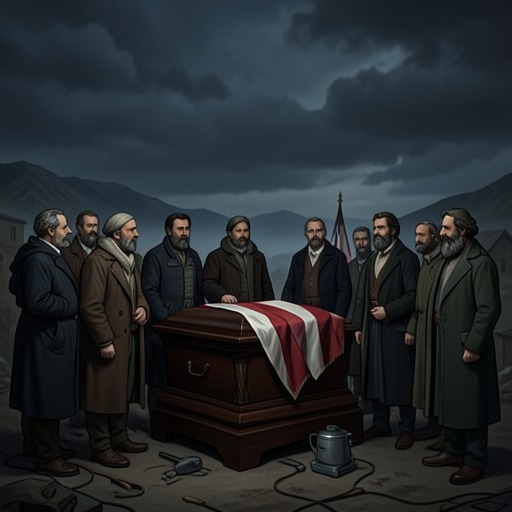
At Akhtem’s funeral, men surround the stretcher after it is brought into the yard. Sergeyich notices that every visitor is wearing a fez and is surprised that all those gathered to say goodbye are men. He does not see Akhtem’s wife, Aisylu, or their daughter, Aisha, near the deceased.
The imam leads the prayers beside the stretcher. Sergeyich understands none of the language, yet experiences the prayer physically; he watches the men bow their heads toward their upturned palms. The scene presents the custom not as an abstract rule but through a sequence of participants, objects, and gestures: the green pall embroidered with golden Arabic script, the men gathered around it, and their shared prayer.
The explanation at home
After the funeral, Sergeyich asks Bekir directly why Aisylu did not attend. Bekir explains that their women and children do not go to the funeral and say their goodbyes at home. This makes explicit what Sergeyich had observed at the burial: the women’s absence from the public rite does not mean that they are absent from mourning, but that their farewell takes place in a different setting.
Aisha’s brief appearance during the family gathering the next day underscores that distinction. She comes out from behind the door to listen when the imam speaks to Bekir and Aisylu; when he points out the burning candle, she blows it out. The episode places her within the household’s observance, but not among the men accompanying Akhtem’s body to the cemetery.
Sergeyich at the boundary of the rite
The procession and burial show how the custom defines Sergeyich’s uneasy place within the mourners’ community. Friends and neighbours take turns carrying Akhtem’s body, while Sergeyich follows at the rear. At the cemetery he stands to one side—not as far off as a detached onlooker, but not as close as someone near and dear to the deceased. Tatar is the only language he hears, and although its sounds grow more distinct to him, their meanings remain unknown.
His presence is therefore both participation and distance. He has come to mourn his friend, yet the procession’s language, prayers, and social boundaries remind him that grief does not automatically make him an insider. The custom gives that boundary a concrete form: the men carry the body through public space, while the women and children take leave at home.
Significance
The funeral custom is one of the practices through which the novel makes religious and communal difference tangible without reducing it to explanation. Sergeyich first encounters its limits by noticing who is missing, then learns the rule from Bekir. Between those moments, the funeral is rendered through his partial understanding: he cannot translate the prayer, but feels its force, and can follow the mourners’ actions without knowing all their meanings.
The resulting contrast is not simply between attendance and absence. Akhtem’s male relatives and neighbours accompany the body; Aisylu and Aisha say goodbye within the home. Sergeyich, meanwhile, crosses into the public rite as a friend but remains at its edge. The custom thus shapes both the funeral’s organization and the novel’s account of how mourning can be shared across a boundary without erasing it.